Shame on you. That’s the purpose of Plagarius, a German cereremony that awards the most blatant knock-off artists. The purpose of the awards is to send a message that stealing innovations is not acceptable.
Having their innovations knocked off in this manner can be an innovator’s worst nightmare. With some money and determination, they can shut down the knock-off artists. This kind of behavior really highlights the law of the market: if you succeed others will imitate.
According to The Wall Street Journal, the public may soon know the names of hundreds of top bankers at Merrill Lynch who received hefty bonuses prior to that company’s merger with Bank of America. Merrill Lynch paid out $3.6 billion in bonuses before it was rescued by its merger with Bank of America.
Bank of America, which has received tens of billions of dollars in taxpayer funds since that merger, recently tried to prevent the disclosure, claiming the banker’s names and salary data are protected by trade secret law. This argument was made in Bank of America’s legal action against New York Attorney General Andrew Cuomo, who requested the bankers’ names and salaries.
On March 18, a New York state judge denied the trade secret claim, saying:
“The record indicates that Bank of America has not taken the kind of measures to protect the secrecy of its employee-compensation information that one would expect it to have taken if this information were a trade secret.”
The judge found that the bankers were not legally required by their employers to keep their salary information secret.In a February 24th deposition, John Thain testified that he did not know of any policy that prevented Merrill Lynch employees from discussing their compensation, and that he knew that bankers routinely mention their compensation to external parties, such as headhunters.
A common measure required to protect trade secrets are legal contracts that prevent disclosures to outside parties. These contracts are called non-disclosure agreements (NDAs). Apparently, neither Bank of America or Merrill Lynch required their bankers to sign NDAs relating to their salaries.
To learn more about trade secret NDAs, please see this prior post.
Here is what Smith says on his site, speaking about Radiohead’s decision to release their In Rainbows album under a donation pricing model:
“ANY FAMOUS ARTIST WITH A HUGE AND DEVOTED FAN BASE(OFTEN ARRIVED AT WITH A LITTLE HELP FROM A WEALTHY AND POWERFUL ‘PATRON’ ORTWO?) CAN AFFORD TO DO WHAT HE, SHE OR IT WANTS… INCLUDING GIVING THEIR ART AWAY AS SOME KIND OF ‘LOSSLEADER’ TO HELP ‘BUILD THE BRAND”
The follks over at TechDirt, however, argue that Smith misses the point. Smith is criticizing the general rule that all art should be free, claiming such a rule or social norm is not beneficial to artists, and is more damaging to those who are not famous. The folks at TechDirt, on the other hand, claim that the point of the “art for free” movement is about business, and that giving some art for free allows artists to share some of the value of art and charge money for related complimentary products or services.
Pop culture critic and journalist C.E. Hanifin recently pointed out a fascinating intellectual property controversy at Target Addict. That blog comments on a news story run by The Virginian-Pilot, involving I.P. and lingerie.
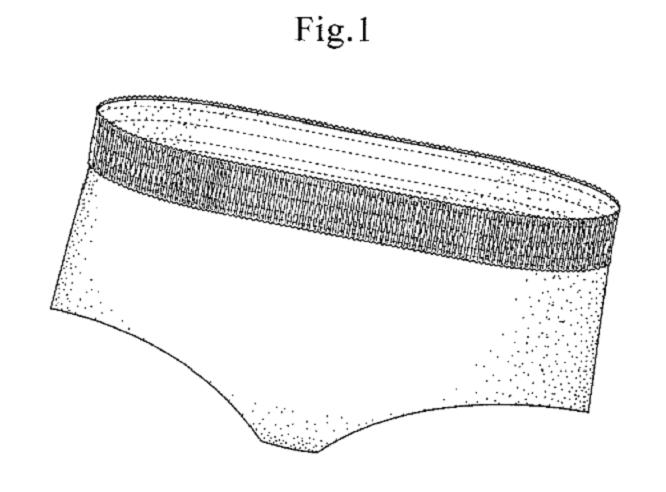
April Spring, of Norfolk Virginia, obtained a design patent in December, 2008 for a design of women’s briefs marketed under her Foxers brand. This is the image of the design patent, as it was issued by the U.S Patent Office.
Design Patent D581,628 for Women's Briefs
Spring’s design attaches an elastic waist band to the briefs, much like those seen on men’s boxer shorts.
Spring filed a lawsuit against Target, Corp. alleging the retailer knocked-off her design. The Foxers briefs are normally priced at between $20 to $26 a pair. The Target briefs that allegedly rip-off her design are priced at around $5 a pair.
Note: design patents are a special type of patent and differ from utility patents, which cover working inventions. Design patents cover only the ornamental look of a product, as opposed to how the product works.
“I have the name Matsuflex. If I can harness that Matsuflex energy, it’s gonna help change America in a positive way!”
Matsuflex
These are the words of Ryan Matsunaga, a.k.a. Matsuflex, one of the participant’s on VH1’s reality t.v. show The Tool Academy. Matsuflex, is one of the program’s finalists and has made a point of advertising his name as often as possible. During a recent show, one of the show’s attendee’s asked “What’s Matsuflex? It sounds like an energy drink.” Here’s another suggestion, a Matsuflex sounds like a pull-up machine hawked on late night t.v. The point is, the name Matsuflex may have real commercial value.
If that is the case, Matsuflex would do well to trademark the name as soon as possible. I ran a quick search at the United States Patent and Trademark Office (USPTO) database and was unable to find a trademark registered as Matsuflex, which means it is still open for someone to claim, so long as they can prove they will offer something for sale called Matsuflex in a particular class of goods or services.
Matsuflex should think about running to the USPTO to claim the name, if he hasn’t done so already. Otherwise, an unscrupulous entrepreneur might take it over, and misappropriate all that positive Matsuflex energy.
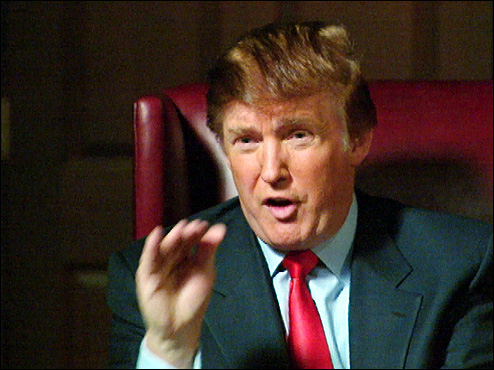
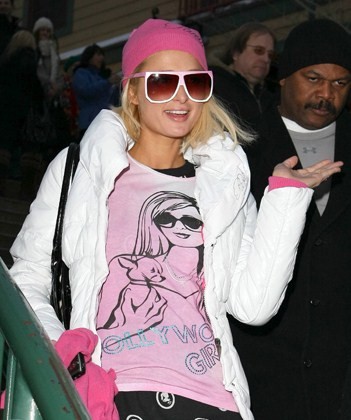
Donald Trump tried to register the phrase “you’re fired” but was denied. Paris Hilton was allowed to register “that’s hot”. What gives? The law of trademark.
Trademark law accomplishes two important objectives: 1) it protects investments to build brand equity in a trademark; 2) it protects consumers from the likelihood of confusion in the marketplace. The second reason explains why the Donald was rejected, and Paris was not.
Another important item to consider is that trademarks are only registered for goods that are actually sold in narrowly defined product markets.
The United States Patent and Trademark Office examiner rejected Donald’s “you’re fired” trademark application in the class of goods for “games”. The rejection was based on a previously registered trademark: “you’re hired”. A company, called Franklin Learning Systems, had registered “you’re hired” for one of its educational board games. The examiner determined that “the similarities between the marks and the goods of the parties are so great as to create a likelihood of confusion.”
In Paris’ case, no one had registered anything similar to “that’s hot” as a federal trademark for the classes of goods and services she applied for, including “men’s and women’s clothing”.
A catchphrase, a.k.a. tag line in marketing parlance, can be registered as a federal trademark if customers recognize the phrase as the source of a product or brand.
Below are three catchphrases associated with particular celebrities. Two of these phrases have been successfully trademarked. Try to guess which one failed to make the cut.
"That's hot""You're fired!""Two thumbs up."
I’ll post the answer this Wednesday, along with a discussion about trademarking catch phrases in general.
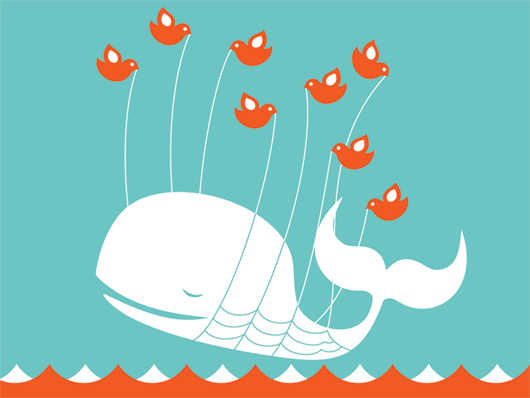
The Fail Whale image was created by Ms. Yiying Lu. Ms. Lu initially created the image to send as an e-card to a friend. Eventually, she uploaded the image to iStockPhoto. Under the iStockPhoto image license terms, the image was made available for a few dollars under a perpetual license.
Things unfolded when Mr. Biz Stone, one of Twitter’s founders, purchased an iStockPhoto license of the whale image. Mr. Stone used the image so it would appear on Twitter whenever that site experienced an outage due to heavy traffic (a smart branding move in my opinion since the image is funny, unexpected and connotes teamwork). The Twitter community quickly grew fond the whale image. One of the fans named the image the “Fail Whale”. Another fan tracked down Ms. Lu and her online fame only grew from then.
There is now a Fail Whale fan club, Flickr site and community art site. In true Web 2.0 spirit, the Fail Whale image has become part of a community’s culture. The community owns the image, freely adapting the image in new ways. It was a community member who first named it the Fail Whale. Many of the community websites use the Fail Whale term without worries about ownership. Here is what the Fail Whale fan site says about itself:
“This site is here to poke fun at the people who seem to take online social network downtime a little too seriously. Failwhale.com is not affiliated with Twitter. Rather, it’s a love letter to the hard working folks at all of our favorite online social networking sites who lose sleep over the concept of scalability.”
The community for all purposes owns the whale. Will that someday change since it has become valuable? Ms. Lu already took the image off the iStockPhoto site which allowed users to perpetually license the image for a low price. She has also recently created an official Fail Whale Merchandise Site. The next logical step to build a business around the Fail Whale is to apply for a trademark, and then license the trademarks for merchandising. (Note: a copyright can eventually become a trademark if it identifies a source of goods).
Will the Fail Whale remain open for the community’s free use? Would that be the best thing? Or, will it be Generation Y’s version of Micky Mouse or Hello Kitty? The next time you see the Fail Whale look closely. You just might see a small round trademark symbol.
P.S. Have you lately come across an intellectual property controversy that piqued your interest? If so, please send it my way.
Artists borrow material to create new art. This practice is widely acknowledged and condoned in art circles. Daniel Grant makes this point in a recent Wall Street Journal article. Mr. Grant also points out, however, that copyright law can potentially render artistic borrowing an unlawful transgression. What is routine practice in the arts may lead to litigation and an intellectual property minefield.
Mr. Grant’s article discusses the Rogers v. Koons case. In that case the renowned artist Jeff Koons was sued by photographer Art Rogers. Mr. Koons made an unauthorized sculptural and literal rendition of a photograph taken by Mr. Rogers that depicted a family with eight puppies. A federal court found that the sculptural representation amounted to copyright infringement. Mr Koons unsuccessfully argued that creating the sculpture from the photograph was a transformative social commentary. This type of commentary, he argued, was an important artistic activity. It was a good argument, but not a legally persuasive one.
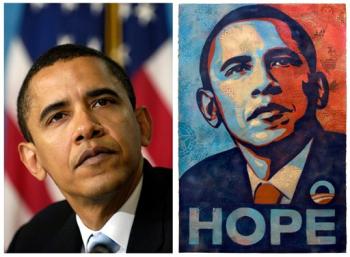
The Rogers v. Koons case was decided in 1992. Seventeen years later, a very similar case is now publicly unfolding. This case also involves an artist and a photographer. In this case, the artist is Shepard Fairey, who created the Obama Poster shown below from a photograph taken by photographer Mannie Garcia. Mr. Garcia, who is a freelance photographer, was working for the Associated Press at the time he took the photograph, shown below next to the poster image. Mr. Fairey based his image on the photograph without asking the Associated Press for permission. Now, Mr. Fairey has sued the Associated Press to have the copyright issue resolved.
AP Photo vs. Mr. Fairey's Rendering
The question, however, remains contested. How can one determine if their new work has unlawfully copied another work? How much borrowing is permitted? Prior cases, like Rogers v. Koons state that an original work is copied when “the accused work is so substantially similar to the copyrighted work that reasonable jurors could not differ on this issue.” That is a fuzzy boundary that is determined on a case-by-case basis.



 professororozco.com