Kanwal Rekhi’s entire lecture (see previous post):
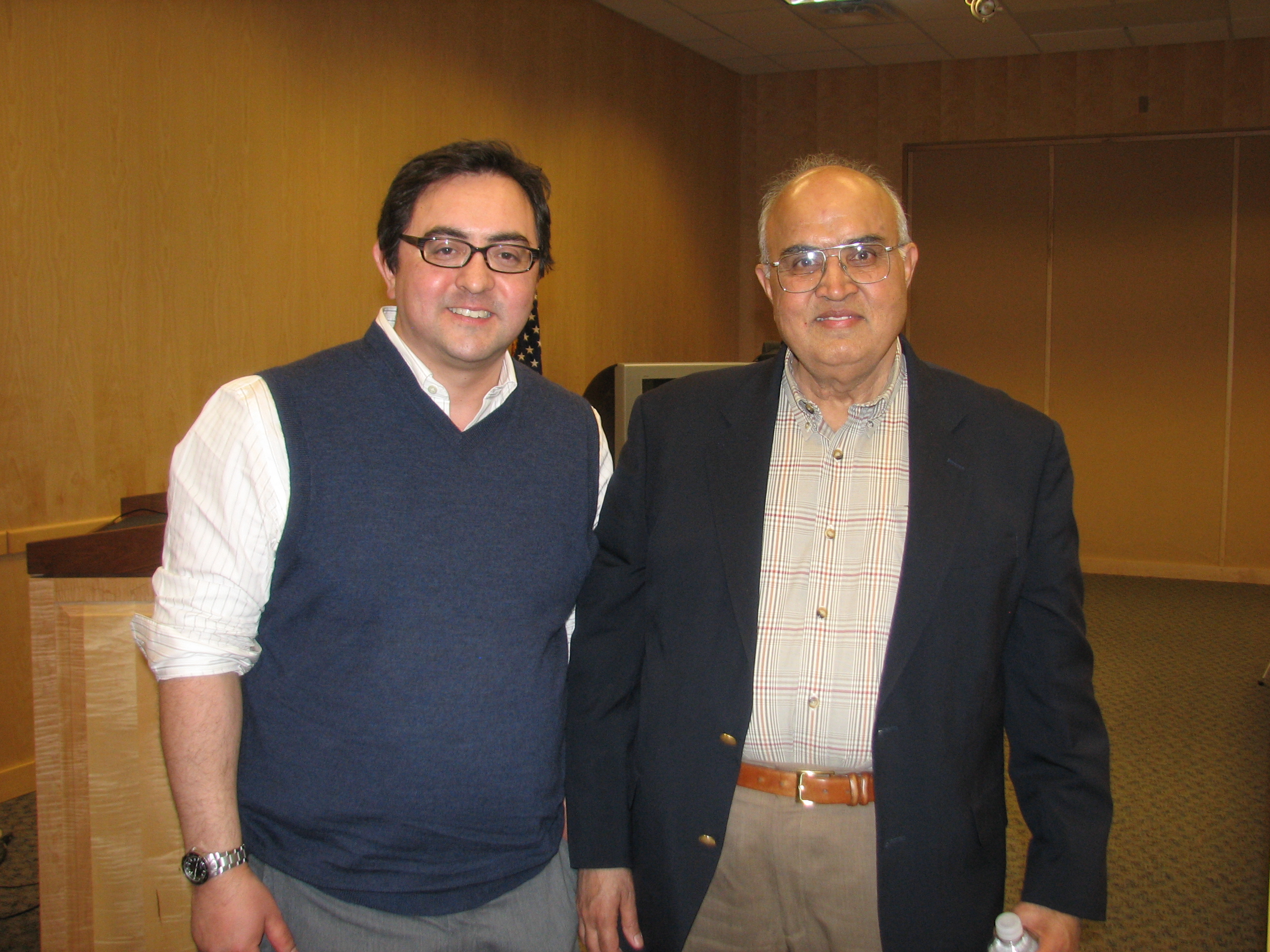
To find out more about his lecture at Michigan Technological University, visit this site.
Kanwal Rekhi’s entire lecture (see previous post):
To find out more about his lecture at Michigan Technological University, visit this site.
Dr. Kanwal Rekhi’s innovations provided the foundations for the Internet. His start-up company, Excelan, developed and sold the computer hardware that allowed distributed computing to flourish, helping to usher in the age of the network. Dr Rekhi eventually sold Excelan to Novell and then eventually became a venture capitalist, helping to fund more than 50 companies in Silicon Valley. Six of them went public.
Michigan Technological University had the honor of hosting this very distinguished alum. Dr. Rekhi received his masters in electrical engineering in 1969 from Michigan Technological University.
I had the unique pleasure of hosting Dr. Rekhi in my Entrepreneurship class. I also attended his lecture on “Entrepreneurship in Hard Times” on March 4, 2009. Dr. Rekhi gave an amazing an inspiring speech. During this speech he spoke about the virtues of bucking the trend, and starting your own business during tubulent times.
These are Dr. Rekhi’s top 10 traits for an entrepreneur. They readily apply to anyone who aspires to innovate:
Top Traits of an Entrepreneur
1. Intellectual honesty. Brutal honesty. You can never fall in love with your business. If you do, you will fail to make the hard but necessary decisions.
2. Humility.
3. Accountability to yourself and your team. You ultimately have to be able to say that you accomplished something or that you did not. If not, why not? You cannot ever blame others. If you fail, it is on your shoulders — no excuses. If there is no accountability at the top, others below also will not feel accountable.
4. Fairness. You have to be able to make sure the rewards are proportional.
5. Economics. You have to be able to determine values and prioritize these values. The highest value-added issues get prioritized. You also have to understand the fundamentals related to costs and margins.
6. Expertise. You have to be an expert when it comes to your customer and competition. Although you also have to quickly become a generalist. You don’t have enough money when you start out to hire specialists.
7. Execution intelligence. Investors pay a premium for this rare skill. For every great idea that you have, there are 10 very smart people with the same idea. What will make the difference is the ability to execute. Ideas are a dime a dozen.
8. Leadership. When times are tough, pull everybody up. Inspire others to look beyond today. When times are good, keep everybody grounded; don’t get too exuberant.
9. Self-reliance. Entrepreneurs do not need any approval. This comes from within. Also, there is little daily satisfaction; success comes in the long run.
10. Confidence. Success loops are long, so you need to be confident and patient to reap your rewards.
“I have the name Matsuflex. If I can harness that Matsuflex energy, it’s gonna help change America in a positive way!”

These are the words of Ryan Matsunaga, a.k.a. Matsuflex, one of the participant’s on VH1’s reality t.v. show The Tool Academy. Matsuflex, is one of the program’s finalists and has made a point of advertising his name as often as possible. During a recent show, one of the show’s attendee’s asked “What’s Matsuflex? It sounds like an energy drink.” Here’s another suggestion, a Matsuflex sounds like a pull-up machine hawked on late night t.v. The point is, the name Matsuflex may have real commercial value.
If that is the case, Matsuflex would do well to trademark the name as soon as possible. I ran a quick search at the United States Patent and Trademark Office (USPTO) database and was unable to find a trademark registered as Matsuflex, which means it is still open for someone to claim, so long as they can prove they will offer something for sale called Matsuflex in a particular class of goods or services.
Matsuflex should think about running to the USPTO to claim the name, if he hasn’t done so already. Otherwise, an unscrupulous entrepreneur might take it over, and misappropriate all that positive Matsuflex energy.
Donald Trump tried to register the phrase “you’re fired” but was denied. Paris Hilton was allowed to register “that’s hot”. What gives? The law of trademark.
Trademark law accomplishes two important objectives: 1) it protects investments to build brand equity in a trademark; 2) it protects consumers from the likelihood of confusion in the marketplace. The second reason explains why the Donald was rejected, and Paris was not.
Another important item to consider is that trademarks are only registered for goods that are actually sold in narrowly defined product markets.
The United States Patent and Trademark Office examiner rejected Donald’s “you’re fired” trademark application in the class of goods for “games”. The rejection was based on a previously registered trademark: “you’re hired”. A company, called Franklin Learning Systems, had registered “you’re hired” for one of its educational board games. The examiner determined that “the similarities between the marks and the goods of the parties are so great as to create a likelihood of confusion.”
In Paris’ case, no one had registered anything similar to “that’s hot” as a federal trademark for the classes of goods and services she applied for, including “men’s and women’s clothing”.
When I teach, I often make references to non-disclosure agreements, a.k.a. the NDA. These contracts are used by innovators to secure their trade secret intellectual property when they disclose the secrets to external parties, such as partners, employees, suppliers, investors, and customers. NDAs are important since they prohibit the external party’s unauthorized disclosure or use of the information.
I am often asked by students, how do I create an NDA? I wish I had heard of this site earlier: “NDAs for Free”.
 professororozco.com