Copyright Battle Over Obama’s Image

Artists borrow material to create new art. This practice is widely acknowledged and condoned in art circles. Daniel Grant makes this point in a recent Wall Street Journal article. Mr. Grant also points out, however, that copyright law can potentially render artistic borrowing an unlawful transgression. What is routine practice in the arts may lead to litigation and an intellectual property minefield.

Mr. Grant’s article discusses the Rogers v. Koons case. In that case the renowned artist Jeff Koons was sued by photographer Art Rogers. Mr. Koons made an unauthorized sculptural and literal rendition of a photograph taken by Mr. Rogers that depicted a family with eight puppies. A federal court found that the sculptural representation amounted to copyright infringement. Mr Koons unsuccessfully argued that creating the sculpture from the photograph was a transformative social commentary. This type of commentary, he argued, was an important artistic activity. It was a good argument, but not a legally persuasive one.

The Rogers v. Koons case was decided in 1992. Seventeen years later, a very similar case is now publicly unfolding. This case also involves an artist and a photographer. In this case, the artist is Shepard Fairey, who created the Obama Poster shown below from a photograph taken by photographer Mannie Garcia. Mr. Garcia, who is a freelance photographer, was working for the Associated Press at the time he took the photograph, shown below next to the poster image. Mr. Fairey based his image on the photograph without asking the Associated Press for permission. Now, Mr. Fairey has sued the Associated Press to have the copyright issue resolved.
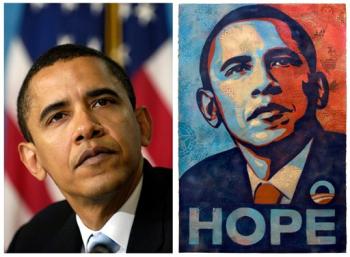
AP Photo vs. Mr. Fairey's Rendering

The question, however, remains contested. How can one determine if their new work has unlawfully copied another work? How much borrowing is permitted? Prior cases, like Rogers v. Koons state that an original work is copied when “the accused work is so substantially similar to the copyrighted work that reasonable jurors could not differ on this issue.” That is a fuzzy boundary that is determined on a case-by-case basis.

So here’s my question:
The anti-Creative Commons

A few weeks ago I was part of a panel on intellectual property controversies at Michigan Tech. One of the comments I made on the panel is that most intellectual property law innovations have been developed by regular people taking intellectual property law into their own hands. For example, Creative Commons, Science Commons and Open Source Software are all innovations created by information creators and users, not lawmakers on Capitol Hill or the judiciary.

A reader recently submitted the website: myfreecopyright.com, which I’ve dubbed the anti-creative commons. Like the legal innovations listed above, this is yet another resource that allows creators to engage their online i.p. and the law in a user-friendly way.

The difference, a big one, is that the myfreecopyright site allows you to notify others of your copyrighted content and allows you to register and date the work through their database. This is achieved in three steps: 1. Upload the work by allowing the site to subscribe to your content; 2. A digital fingerprint of the work is created; 3. The work is registered on the database.

Why go through this? Here is what the myfreecopyright site says:

“You should provide evidence of your Copyright on all public displays of your original creations so that nobody can claim they thought your creation was part of the public domain. The Public Domain consists of original creations available Copyright Free to the whole public. Copyright Infringers often claim the public domain defense, and can be let off the hook, if no public display was with your original creations defining your Copyright.”

What I find so interesting about this is that the Library of Congress is the official place for authors to register federal copyrights. Authors obtain copyright when they create the work in a tangible medium, but they can register it. Authors register their works to have the right to sue in federal court and obtain the high damages stipulated by federal laws. The myfreecopyright site does not register your copyrights in the Library of Congress, and does not help you locate and pursue infringers. It does (as mentioned above) put everyone on notice that you have claimed a copyright and have registered it in a public database, which hinders unauthorized users from claiming the public domain defense. This is another private technology solution to intellectual property law. In this way, it’s another example of how everyday folks are innovating and engaging their intellectual property, participating in what I call law 2.0

Pimp My Trademark

I recently watched the MTV show “Pimp My Ride“, in which people with junkers contact the show with the hopes of getting their cars souped -up. The show I happened to watch involved a pretty beaten up Honda Civic. During the car’s transformation, the team installed Lambo doors on the Civic. Lambo doors are car doors that swing up like those in the famous Lamborghini models from the ’80’s (just think of Miami Vice).

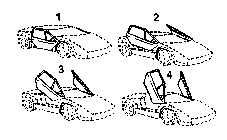
I recalled seeing a trademark at one point owned by Lamborghini on the motion of its doors. I did a little research at the U.S. Trademark Office and found the live trademark registration # 2793439 owned by Lamborghini. Here is the image of the trademark as it is currently registered to the company:

Image of car doors swigning up to open.
Image of car doors swinging up to open.

This registered trademark was issued to Lamborghini in 2003 and “consists of the unique motion in which the door of a vehicle is opened. The doors move parallel to the body of the vehicle but are gradually raised above the vehicle to a parallel position. The matter shown in dotted lines is not part of the mark.”

Did Lamborghini license this trademark to the folks involved in MTV’s program? If not, did they commit trademark infringement?

It seems that several companies make and sell kits that allow mechanics to transform any old regular car doors into the pimped out Lambo doors. Most of the kits I have seen advertise the doors as “Lambo doors”, giving proper attribution to Lamborghini as the pioneers.

Back to the trademark infringement. It seems to me that the kit manufacturers would not be infringing the trademark shown above since they are only selling the specialized hinges that make the car doors rotate upwards. That is a functional product (subject to patent laws) and not trademark, which only extends to source identity. If you go back the trademark listed above, Lamborghini owns the right to how car doors actually move on an actual car. So, perhaps the person who owns the car commits the trademark infringement every time they open and close their car doors!

Is Lamborghini going to do the same thing the recording industry has done and go after individuals? Let’s hope they have better things to do.

Google’s Book Democracy?

A reader sent me this New York Times  article that explains Google’s book project, which recently had to settle copyright infringement lawsuits filed by authors. With the new Google service we will all have greater access to information, a lot of which is under copyright. However, the full service appears to be limited to subscribers. The loophole is that public libraries will have a terminal that allows visitors to access the database for free.

If you come across any interesting intellectual property controversies, please send them my way.

Law 2.0 – Harnessing the Web to gather legally relevant data

The Web has transformed how we gather, process and view information. Yet, the legal system has largely ignored the Web’s vast potential to settle legal issues. Just one possible way for the Web to improve the efficiency of legal determinations is through online surveys, which are cost efficient and quickly obtained.

Surveys are often used in intellectual property-related issues to empirically determine facts which are then interpreted to settle a question of law. For example, in trademark law, surveys are used to prove whether a competitor’s  trademark is likely to cause consumer confusion. If it is, then the plaintiff is provided some sort of legal relief. All to often, each side offers their own surveys developed by their own experts to advance their claims.

So here is a thought experiment proposal; why not use online surveys to gather facts that can then beused to decide legal outcomes?  Why not open up the survey questions to an online community to gather facts? I think doing this might make the system more efficient, speedy, and unbiased. It would also include interested public participants and show the public how the system works, and what their beliefs and survey responses mean from a legal standpoint. Including the public this way could enrich our legal system.

What are some of the problems that might arise from this system? An obvious one is that one side might try to influence responses. Technology might provide an answer through a secured response system. Another alternative is to limit the sampling to a closed user group. Better yet, a response similar to open platforms like Wikipedia might emerge. A completely open community of responders, who have some interest or stake in the legal question, would theoretically offer an accurate appraisal of the public’s view.

Another problem would arise in deciding who frames the questions. Whoever gets to define the scope of questions has a great amount of discretion.

In spite of these difficulties, which are likely surmountable, the question lingers: Why has our legal system failed to harness the Web for fact gathering? Is it falling too far behind the times? Is it too entrenched in its formal, text-based culture?

I’d love to hear your thoughts and reactions to this question.

Copyright out of control?

Techdirt does a nice job describing some of the problems currently facing artists and copyright. Basically, how can you artistically innovate without borrowing?

This is in response to a copyright-related story that recently popped up dealing with the iconic blue, white and red Obama campaign posters. As it turns out, the original image was a photograph taken by an Associated Press freelance photographer. The image was downloaded and altered by someone else to generate the iconic poster image. All this was done without getting the photographer or the A.P.’s permission, and in theory violating their copyright.

The value of news

New York Times Op-ed piece recently commented on how newspapers should consider switching to an endowment model supported by philanthropy vs. the current attempt to operate and survive as for profit enterprises.

I particularly like the Thomas Jefferson quote,  “The basis of our governments being the opinion of the people, the very first object should be to keep that right. And were it left to me to decide whether we should have a government without newspapers or newspapers without a government, I should not hesitate to prefer the latter.”

I got wind of this article by a a blog discussion written by Dan Gillmor at the Center for Citizen Media. Dan’s post criticizes the overall logic of preserving the current model, with all of its flaws, through the endowded non-profit model. Praise is given, however, to the article’s effort to suggest new models to sustain journalism, a vital endeavor in any free and progressive society.

The deeper question, may not be about which model works best, in either a for profit, or non-profit model. It might instead concern how we consume and value factually accurate and relevant information. My sense is that future generations seem less interested in objective truth and information. As a society, we should all be very concerned.

A librarian’s perspective

Molly Kleinman, the fourth speaker of the lecture series (see posts below),  is a copyright specialist and librarian at the University of Michigan. Her job hinges on allowing people to achieve their research goals, and her job at times can be impeded by copyright laws. 

I asked her if she viewed Google as a threat to libraries. They’re not, to her. They actually make her job easier and serve as just another tool.

She also mentioned how libraries and their special databases are often unrecognized, since Google uses them extensively but never tells you that they are using a library’s database.

A big concern Molly has with copyright is that in the pre-Web era, libraries could buy a phyiscal copy of a book or journal and keep the tangible copy as long as it did not disintegrate. Now, she has seen an increased trend in licensing content. Basically, the libraries are owning less and less physical materials, and hence are owning less physical content. When they license the information, the terms of a license contract dictate the terms of use. These terms often mean no copying, no backing up, no storing in other devices, and no saving on the shelf. This means the library has to keep re-paying the content owner for re-newed access to the information periodically. This has been great for content owners who have shifted their information to digital platforms. But this is bad for the consumer who now no longer owns any tangible product where the data has been stored.

If this keeps happening, used book stores might be out of business some day?

Boundless trademarks

Trademarks have a dual purpose: to prevent consumer confusion by preventing any company from usurping the identity of another firm; they also are private property rights that secure a company with goodwill and brand equity.

Trademarks have lately been controversial since the scope of trademark property has expanded a lot in recent times. Some trademarks can even legally become “famous”. When a mark is legally recognized as famous it can stop other users of the mark even if there is zero consumer confusion. This has created problems for companies in totally different markets and contexts who try to use a similar mark that no one would confuse with the famous mark, e.g. using rolls royce for a dry cleaning service. It has also created problems for people who try to comment on a brand through parody or social commentary (see discussion thread below dealing with the Barbie). Owners of famous marks can potentially censor others who tarnsih the mark in any way.

The other controversial development is the use of trademarks to cover sensory perception, e.g.  strange trademarks, where companies secure a property right to things like sounds, colors, shapes and motion. That was the subject of my recent lecture, and a Wall St. Journal article I wrote last year about how Apple received a shape trademark for the iPod. If you would like to see the recent lecture slide show please click here:

The Shape of Things to Come: Non-Traditional Trademarks from the iPod to the Chippendale Dancers

I’d love to hear about what your  thoughts are on trademarks!