That’s a pretty big sum for a trademark infringement case, litigated in a federal court in Northern California. What is interesting is it wasn’t levied against some knock off artists directly. Instead, the charge was contributory infringement (kind of like aiding and abetting) against web site hosts that allowed fake L.V. hand bags to be sold via the Web. This ruling will potentially have a big impact in the world of online retail. The case bears some similarity to Napster, which dealt with copyrights and online music exchanges. In the L.V. case, however, it will be much harder in the future for fake goods sellers and their web hosts to escape unnoticed. This is, in sum, a big victory for trademark owners.
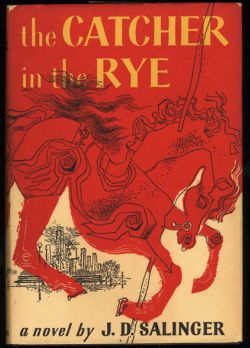
A federal judge in New York upholds J.D. Salinger’s copyright and issued an injunction to prevent a modified version of “Catcher in the Rye” from being published in the U.S. The New York Times reports the story here.
J.D. Salinger, author of the classic Catcher in the Rye novel filed a lawsuit in Manhattan alleging that the authors of a sequel to his acclaimed novel have committed copyright infringement. In the complaint, Mr. Salinger alleges that the unauthorized sequel involves an elderly Holden Caulfield who leaves a retirement home to spend a few days in New York City.
Salinger asserts that his copyright to the first work grants him the exclusive right to authorize any derivative works of that prior and seminal work of fiction. The complaint alleges that the new sequel is an unauthorized derivative, and Mr. Salinger requests the court to grant an injunction against its publication, sale and distribution.
Given the nature of Mr. Salinger’s copyright, and if the injunction is granted, many of us will probably never know how phony or lousy that sequel may have really been.
President Obama’s Supreme Court Justice nominee, Judge Sonia Sotomayor, has ruled on important intellectual property cases in the past. This is a good thing, since the U.S. Supreme Court has recently re-shaped intellectual property law, and adding an Justice with experience in this area is important for future cases dealing with the law of innovation.
Judge Sotomayor wrote an opinion in 2002 that created a strong precedent for cases involving license contracts involving software downloads. That case was Specht vs. Netscape, where Judge Sotomayor ruled that Netscape’s software license terms were not binding on individuals who clicked the prominent download button at the top of the screen before scrolling down to click on the link that opened the license terms.
As a result of this decision, companies now routinely require users to manifest their acceptance of the license terms by clicking on a check box before downloading software.
The subject of the talk is patent advocacy before the U.S. Supreme Court. My co-author James Conley and I have measured the patent advocacy of various types of firms when they file briefs before the highest court of the land. In the past few years, the Supreme Court has taken a more active role in shaping patent laws and policy. This is in contrast to Congress, which has largely stalled in the area of patent reform.
What are some of the key issues facing patent reform today?
First, there is the issue of first-to-invent vs. first-to-file. The U.S. is one of the few countries that follows the first-to-invent rule. In most other countries, whoever wins the race to the patent office gets the patent (first-to-file rule). According to one senior Patent Office official I spoke with recently, there is a strong chance we might adopt the first-to-file rule. Some believe this would favor large companies over the small inventor.
Another major issue is damages. Patent infringement damages, particularly if the infringement is found to have been willful, can be extremely high. Some advocates, particularly the larger companies, want to limit damages.
Some of the theses issues have been recently addressed by the Supreme Court, the topic of our research.
I met Allan Tokuda when I was a Teaching and Research Fellow at Northwestern University. I was helping teach a course on Innovation and Invention in the engineering program. Allan was one of the brighter and more inquisitive students. I knew he had some remarkable qualities when, before class one day, he took out a Rubik’s Cube. He could consistently scramble the puzzle and solve it in less than two minutes.
Allan and I eventually put our minds together to attack the problem of patent claim language and its obfuscating qualities. Allan brought top notch software coding and logical analysis. I brought my knowledge of claims and claim structures and the problems lay people and inventors routinely face when they try to read these sentences. Patent claims, for those new to patents, are the legal definition that describes the property boundaries of a patented invention. Patent claims are what get litigated in court and are located at the very end of the patent document.
The result of our combined efforts is something called the Patent Piler (at this Website). It is an open source project and resource guide that allows anyone to look up a patent by the patent number, search and compare any of that patent claims with other claims in the patent. Here is an image of how it works.
Patent Piler
The tool, as shown above, highlights the differences between claims in the same patent.
Why is this useful? Oftentimes the most confusing thing about reading patent claims is distinguishing why one claim is different from another. One claim might be different from another due to a difference of just a few words.
The software also does useful things like break down claims by their type, for example methods, products, chemical compounds or machines. The software also allows you to select independent claims, those claims which stand by themselves and are modified by subsidiary claims, called dependent claims.
Try it out for yourself. If you don’t have a specific patent to analyze, try inputting this curious patent number in the box: 6584450
If you like to code and want to make reading patent claims easier, try improving the source code, it is freely available at this site.
A quick note: for now the software runs great on Firefox, not so great on Internet Explorer.
As the name of LMGTFY implies, the site shows you how to search Google if you follow the simple steps listed on the site. I showed the website in class, and one student immediately thought it was a joke. “That’s not so unique” was one comment. “Why not get rid of the middleman and go straight to Google?” another student asked.
As it turns out, the website is dedicated “to all those people that find it more convenient to bother you with their question rather than google it for themselves.” So, if you receive an annoying question, rather than ignore the person or say something nasty, you can send them to LMGTFY and hope they get the message not to bother you again.
The website raises some intellectual property issues, however. I asked the class if they would be willing to invest in this company. The site apparently is trying to raise advertising revenues and claims to have a “steady stream of traffic made up primarily of affluent 30-somethings.” They also claim to have received 1.25 million visitors in February. One student said he would not invest because Google would be able to “shut them down fairly quickly”.
Under what grounds? First, there is the possible trademark issue since the Google trademark and logo are used on the site. Also, the Google website is secured under copyright.
According to The Wall Street Journal, the public may soon know the names of hundreds of top bankers at Merrill Lynch who received hefty bonuses prior to that company’s merger with Bank of America. Merrill Lynch paid out $3.6 billion in bonuses before it was rescued by its merger with Bank of America.
Bank of America, which has received tens of billions of dollars in taxpayer funds since that merger, recently tried to prevent the disclosure, claiming the banker’s names and salary data are protected by trade secret law. This argument was made in Bank of America’s legal action against New York Attorney General Andrew Cuomo, who requested the bankers’ names and salaries.
On March 18, a New York state judge denied the trade secret claim, saying:
“The record indicates that Bank of America has not taken the kind of measures to protect the secrecy of its employee-compensation information that one would expect it to have taken if this information were a trade secret.”
The judge found that the bankers were not legally required by their employers to keep their salary information secret.In a February 24th deposition, John Thain testified that he did not know of any policy that prevented Merrill Lynch employees from discussing their compensation, and that he knew that bankers routinely mention their compensation to external parties, such as headhunters.
A common measure required to protect trade secrets are legal contracts that prevent disclosures to outside parties. These contracts are called non-disclosure agreements (NDAs). Apparently, neither Bank of America or Merrill Lynch required their bankers to sign NDAs relating to their salaries.
To learn more about trade secret NDAs, please see this prior post.
Pop culture critic and journalist C.E. Hanifin recently pointed out a fascinating intellectual property controversy at Target Addict. That blog comments on a news story run by The Virginian-Pilot, involving I.P. and lingerie.
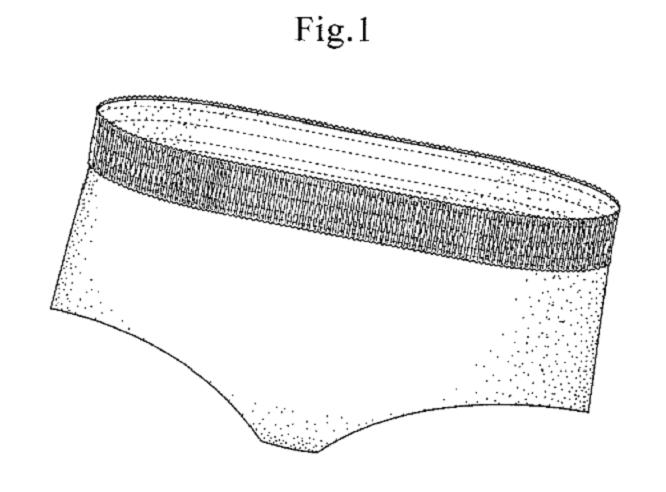
April Spring, of Norfolk Virginia, obtained a design patent in December, 2008 for a design of women’s briefs marketed under her Foxers brand. This is the image of the design patent, as it was issued by the U.S Patent Office.
Design Patent D581,628 for Women's Briefs
Spring’s design attaches an elastic waist band to the briefs, much like those seen on men’s boxer shorts.
Spring filed a lawsuit against Target, Corp. alleging the retailer knocked-off her design. The Foxers briefs are normally priced at between $20 to $26 a pair. The Target briefs that allegedly rip-off her design are priced at around $5 a pair.
Note: design patents are a special type of patent and differ from utility patents, which cover working inventions. Design patents cover only the ornamental look of a product, as opposed to how the product works.
A few weeks ago I was part of a panel on intellectual property controversies at Michigan Tech. One of the comments I made on the panel is that most intellectual property law innovations have been developed by regular people taking intellectual property law into their own hands. For example, Creative Commons, Science Commons and Open Source Software are all innovations created by information creators and users, not lawmakers on Capitol Hill or the judiciary.
A reader recently submitted the website: myfreecopyright.com, which I’ve dubbed the anti-creative commons. Like the legal innovations listed above, this is yet another resource that allows creators to engage their online i.p. and the law in a user-friendly way.
The difference, a big one, is that the myfreecopyright site allows you to notify others of your copyrighted content and allows you to register and date the work through their database. This is achieved in three steps: 1. Upload the work by allowing the site to subscribe to your content; 2. A digital fingerprint of the work is created; 3. The work is registered on the database.
Why go through this? Here is what the myfreecopyright site says:
“You should provide evidence of your Copyright on all public displays of your original creations so that nobody can claim they thought your creation was part of the public domain. The Public Domain consists of original creations available Copyright Free to the whole public. Copyright Infringers often claim the public domain defense, and can be let off the hook, if no public display was with your original creations defining your Copyright.”
What I find so interesting about this is that the Library of Congress is the official place for authors to register federal copyrights. Authors obtain copyright when they create the work in a tangible medium, but they can register it. Authors register their works to have the right to sue in federal court and obtain the high damages stipulated by federal laws. The myfreecopyright site does not register your copyrights in the Library of Congress, and does not help you locate and pursue infringers. It does (as mentioned above) put everyone on notice that you have claimed a copyright and have registered it in a public database, which hinders unauthorized users from claiming the public domain defense. This is another private technology solution to intellectual property law. In this way, it’s another example of how everyday folks are innovating and engaging their intellectual property, participating in what I call law 2.0
 professororozco.com