Use I.P. To Increase Your Company’s Value

In the knowledge economy, two-thirds of a company’s balance sheet assets are comprised of intangible assets. The true value of companies no longer resides in factories or real estate. It resides in the minds of talented employees and in the intellectual property these employees generate, properties like trademarks, trade secrets, designs, know-how, copyrights and patents.

Yet intellectual property is notoriously hard to value. Why? Because unlike most other assets, there is no transparent public market that matches many buyers and sellers. Also, intellectual property is often highly specialized and context-specific, making it hard to develop value models based on similar transactions.

A similarly difficult value determination involves setting a price on your start-up, since there are few cash flows. However, as entrepreneurship guru Tim Berry mentions in his post “5 Concerete Steps to Starting Valuation“, the value of your start-up depends on the “cards you bring to the table.” As Tim mentions, you can improve your hand by owning a defensible product with intellectual property. So, before you shop around for investors, build a portfolio of intellectual property rights and use them as bargaining chips to negotiate value. It can mean the difference between giving up a majority stake in your business vs. giving up only a minority stake.

To learn more about intellectual property valuation methods click here.

Borrowing Blue

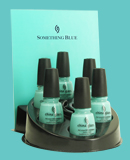
Smart marketing. That is what comes to mind when I think about what China Glaze has done with the branding behind its For Audrey nail polish. Take a look at the product.

For Audrey Nail Lacquer Ad
Something Blue Counter Display

Did you notice the clever associations the nail polish company created by relating the product to the blue color associated with an iconic jewelry store? Or the movie with that store’s name?

On its Web site, China Glaze calls this product a “Tiffany inspired turquoise creme nail lacquer”. But the word “Tiffany” does not appear anywhere on the nail polish bottles or the store displays.

Why is this all so clever? Because the color conjures up images of exclusivity, allure, romance and also a bit of decadence. How did this come about? There is actually a trademark tale behind it all. Tiffany & Co. owns the trademark exclusive rights to use the color robin’s egg blue for boxes, shopping bags, packaging and catalogs in various markets, including fragrances, tableware and crystal. The famous luxury retailer has done a magnificent job of managing this exclusive trademark color in the market for high-end luxury items.

Has China Glaze infringed the color trademark owned by Tiffany & Co.? Not likely since their nail lacquer is not included in the above categories.

Will Google Shut Down Copycat Site?

A student in my Entrepreneurship class recently made me aware of the site: “Let me Google that for you” .com (LMGTFY).

As the name of LMGTFY implies, the site shows you how to search Google if you follow the simple steps listed on the site. I showed the website in class, and one student immediately thought it was a joke. “That’s not so unique” was one comment. “Why not get rid of the middleman and go straight to Google?” another student asked.

As it turns out, the website is dedicated “to all those people that find it more convenient to bother you with their question rather than google it for themselves.” So, if you receive an annoying question, rather than ignore the person or say something nasty, you can send them to LMGTFY and hope they get the message not to bother you again.

The website raises some intellectual property issues, however. I asked the class if they would be willing to invest in this company. The site apparently is trying to raise advertising revenues and claims to have a “steady stream of traffic made up primarily of affluent 30-somethings.” They also claim to have received 1.25 million visitors in February. One student said he would not invest because Google would be able to “shut them down fairly quickly”.

Under what grounds? First, there is the possible trademark issue since the Google trademark and logo are used on the site. Also, the Google website is secured under copyright.

Knock-Off Awards

Can you tell the difference?

Shame on you. That’s the purpose of Plagarius, a German cereremony that awards the most blatant knock-off  artists. The purpose of the awards is to send a message that stealing innovations is not acceptable.

Having their innovations knocked off in this manner can be an innovator’s worst nightmare. With some money and determination, they can shut down the knock-off artists. This kind of behavior really highlights the law of the market: if you succeed others will imitate.

Click here for the full BusinessWeek story.

Acknowledgment: Thanks to Arvind Natarajan for sending me the link to this story.

What A Business Plan Competition Judge Looks For

Successful entrepreneurs write good business plans. Good business plans win competitions.

I routinely conduct business plan competitions in my entrepreneurship class. As part of the job, I have to recruit savvy and successful entrepreneurs to serve as judges for each competition. Someone who I have often asked to judge is Dan Brown, President of Loggerhead Tools and inventor of award-winning and blockbuster products like the Bionic Wrench. Dan is a true entrepreneur and master of industrial design, patenting, marketing and merchandising.

This year, I want to give my students a leg-up and show them what expert judges look for in a business plan competition. So, naturally, I asked Dan. Here is what he replied.

Dan’s Top 10 Business Plan Presentation Topics:

1. Is there a market opportunity? Does your product or service address an unmet or underserved need and add value to customers?

2. Identify and claim your white space. Have you identified a market segment best suited to establish a strategic foothold for launch?

3. Claim an opportunity gap. Have you realistically identified your competition,  and is there an opportunity for sales based on a value-added strategy?

4. Carefully define the wow-factors. What are the customer-getting differences that add value and compete for the customer’s attention and dollars?

5. Are there opportunities for intellectual property protection? Look at patents, trade names, trade dress and other brand-reinforcing strategies. Do a thorough intellectual property search to be sure there will be no unpleasant surprises after launch.

6. Research several competitive benchmarks and quantify the cost and sales drivers necessary for success in the market.

7.  Have a thorough and realistic development, investment and sales budget, with a realistic cost analysis for development, tooling, and commercialization. Know your costs.

8. Develop a roadmap. Develop an actionable plan that identifies the resources, costs and time required to complete product development and commercialization.  Failure to plan is planning to fail.

9. Generate a simple pro-forma (forward-looking) 3-year sales forecast of investment, cost, and projected revenue with a cash flow analysis. Do you show a return on investment?  Do the numbers support your plan?

10. Assemble a winning management team and advisory board that can succesfully complete the development, commercialization and management of your business.

Kauffman Foundation Lecture

I just finished leading an intellectual property workshop for entrepreneurs here in Houghton, MI. The event was sponsored by the SmartZone, a local high-tech business incubator.

The FastTrac TechVenture Program is a learning program administered by the Kauffman Foundation. Here are some of the topics covered in this program:

  • Determine market opportunities and business strategies and pursue them successfully.
  • Define your target customers.
  • Develop a solid marketing plan.
  • Learn to assess and build a top management team.
  • Calculate the funding needed at each stage of your business and discover the best ways to access it.
  • Learn the importance of protecting your intellectual property through licenses, patents, trademarks, and copyrights.
  • Hone your elevator pitch and investor presentation.

One question was asked, and I think it would be useful to highlight. A participant asked,  “If a small technology entrepreneur has a valuable idea, what can they do to save money and protect their idea from a large company that just takes it without permission?”

Here’s a brief checklist:

1. Make sure you are an expert in your technology space. The more you know what the state of the art is, the less time and money you will spend defining your invention during the patenting process.

2. Understand the nature of your intellectual property rights. If you have a broad and solid patent, you can obtain, or threaten to obtain, a speedy injunction to stop competitors from copying your technology.

3. Patent litigation can be very expensive, with a full patent trial costing millions of dollars. A technology entrepreneur can share the expense of a patent trial with a contingency fee patent litigator. Several law firms specialize in taking these cases if: the inventor has a strong patent, there is a clear case of infringement, and the accused infringer has deep pockets. Here is one law firm that specializes in these cases.

Wall St. Bonuses Are Not Trade Secret

According to The Wall Street Journal, the public may soon know the names of hundreds of top bankers at Merrill Lynch who received hefty bonuses prior to that company’s merger with Bank of America. Merrill Lynch paid out $3.6 billion in bonuses before it was rescued by its merger with Bank of America.

Bank of America, which has received tens of billions of dollars in taxpayer funds since that merger,  recently tried to prevent the disclosure, claiming the banker’s names and salary data are protected by trade secret law. This argument was made in Bank of America’s legal action against New York Attorney General Andrew Cuomo, who requested the bankers’ names and salaries.

On March 18, a New York state judge denied the trade secret claim, saying:

“The record indicates that Bank of America has not taken the kind of measures to protect the secrecy of its employee-compensation information that one would expect it to have taken if this information were a trade secret.”

The judge found that the bankers were not legally required by their employers to keep their salary information secret.In a February 24th deposition, John Thain testified that he did not know of any policy that prevented Merrill Lynch employees from discussing their compensation, and that he knew that bankers routinely mention their compensation to external parties, such as headhunters.

A common measure required to protect trade secrets are legal contracts that prevent disclosures to outside parties. These contracts are called non-disclosure agreements (NDAs). Apparently, neither Bank of America or Merrill Lynch required their bankers to sign NDAs relating to their salaries.

To learn more about trade secret NDAs, please see this prior post.

Finding The Hidden Customer

Invention is defined as “discovery, finding” by The Mirriam-Webster Dictionary.

National Public Radio (NPR’s) On the Media reports this story about an inventive print newspaper:

Print newspapers are either dying, or dead. That is the common wisdom. Yet, El Diario, the largest Spanish speaking newspaper, is thriving .The reason why is because it has targeted an audience that mainstream newspapers have largely ignored: immigrants and working-class readers. As the editor of El Diario said in the NPR show:

“There are large pockets of our society that are simply not covered.”

What does this thriving ethnic-media case study teach us?

It teaches the value of filling a void in the marketplace and embracing a niche that cannot be readily served by competitors. Large print newspapers targeted suburban readers who later abandoned print news for free online media. Filling an under-served  niche nimbly is something that large organizations often fail to do, leaving room for entrepreneurial firms like El Diario.

The fragmentation and localization of markets is happening all around us. It happened in the music industry, as listeners continually migrate to online communities. It has also recently occurred in finance, as people migrate back to their local credit unions and micro-loan sites to obtain financing no longer provided by big banks.

If you are an entrepreneur, there is no better time to capitalize on this growing go local movement.

Seeking Female Inventor – Apply Within

Bed Bath & Beyond has partnered up with EdisonNation to sponsor a competition that will reward the next great home product, invented by a woman. The competition commemorates the 200 year anniversary of the first patent granted to a female inventor, Mary Kies for a weaving process in 1809.

Throughout the years, women have patented many important inventions. Here’s a short list of several:

  1. Heddy Lamar – Early wireless technology pioneer (and Hollywood actress)
  2. Mary-Dell Chilton – Biotechnology pioneer
  3. Anna Connelly – The fire escape
  4. Bette Nesmith Graham – Correction fluid
  5. Sharen Brower – Soy-based ink

So, if any ladies have an idea for an invention that would make life easier at home, this might be a good opportunity. The deadline for submissions is April 30.

To learn more, please visit the competition website.

we_can_do_it

Art for Free?

Robert Smith, lead singer of The Cure, has recently gained a lot of attention by publicly criticizing the growing  “art for free” movement.

Here is what Smith says on his site, speaking about Radiohead’s decision to release their In Rainbows album under a donation pricing model:

“ANY FAMOUS ARTIST WITH A HUGE AND DEVOTED FAN BASE(OFTEN ARRIVED AT WITH A LITTLE HELP FROM A WEALTHY AND POWERFUL ‘PATRON’ ORTWO?) CAN AFFORD TO DO WHAT HE, SHE OR IT WANTS… INCLUDING GIVING THEIR ART AWAY AS SOME KIND OF ‘LOSSLEADER’ TO HELP ‘BUILD THE BRAND”

The follks over at TechDirt, however, argue that Smith misses the point. Smith is criticizing the general rule that all art should be free, claiming such a rule or social norm is not beneficial to artists, and is more damaging to those who are not famous. The folks at TechDirt, on the other hand, claim that the point of the “art for free” movement is about business, and that giving some art for free allows artists to share some of the value of art and charge money for related complimentary products or services.

Which viewpoint do you think is the right one?