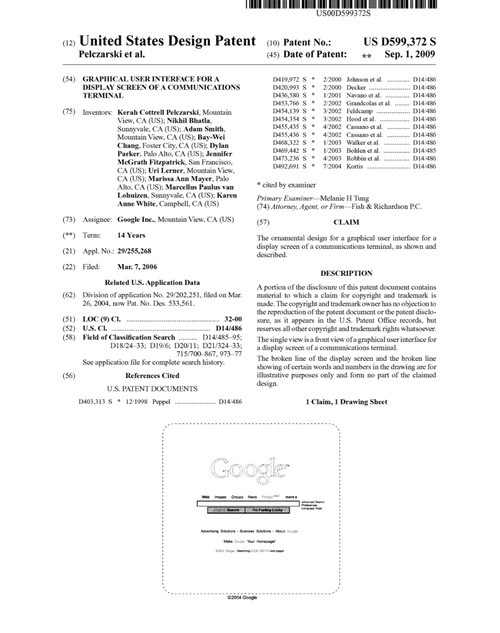
For some time now, I have noticed how Google has obtained several design patents for its website and user interface. See below.
Google Homepage Design Patent
They also recently applied for and obtained a new design patent for the layout of search results. Click here to see it.
A design patent is not your typical patent, and it only secures the aesthetic ornamental aspects of the goods.
Nothing is stopping Google from trademarking its clean, minimalist web interface. In fact, I wrote an article in The Wall Street Journal a while back on how Apple used this very strategy to obtain a shape trademark for its iPod and iPhone.
My most recent search of Google’s nearly 100 live trademarks, however, shows they have yet to learn from Apple’s trademark strategy success.
UPDATE: Please see this newer post to learn about additional ways to secure a website’s design and functionality.
The subject of the talk is patent advocacy before the U.S. Supreme Court. My co-author James Conley and I have measured the patent advocacy of various types of firms when they file briefs before the highest court of the land. In the past few years, the Supreme Court has taken a more active role in shaping patent laws and policy. This is in contrast to Congress, which has largely stalled in the area of patent reform.
What are some of the key issues facing patent reform today?
First, there is the issue of first-to-invent vs. first-to-file. The U.S. is one of the few countries that follows the first-to-invent rule. In most other countries, whoever wins the race to the patent office gets the patent (first-to-file rule). According to one senior Patent Office official I spoke with recently, there is a strong chance we might adopt the first-to-file rule. Some believe this would favor large companies over the small inventor.
Another major issue is damages. Patent infringement damages, particularly if the infringement is found to have been willful, can be extremely high. Some advocates, particularly the larger companies, want to limit damages.
Some of the theses issues have been recently addressed by the Supreme Court, the topic of our research.
I met Allan Tokuda when I was a Teaching and Research Fellow at Northwestern University. I was helping teach a course on Innovation and Invention in the engineering program. Allan was one of the brighter and more inquisitive students. I knew he had some remarkable qualities when, before class one day, he took out a Rubik’s Cube. He could consistently scramble the puzzle and solve it in less than two minutes.
Allan and I eventually put our minds together to attack the problem of patent claim language and its obfuscating qualities. Allan brought top notch software coding and logical analysis. I brought my knowledge of claims and claim structures and the problems lay people and inventors routinely face when they try to read these sentences. Patent claims, for those new to patents, are the legal definition that describes the property boundaries of a patented invention. Patent claims are what get litigated in court and are located at the very end of the patent document.
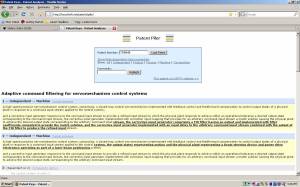
The result of our combined efforts is something called the Patent Piler (at this Website). It is an open source project and resource guide that allows anyone to look up a patent by the patent number, search and compare any of that patent claims with other claims in the patent. Here is an image of how it works.
Patent Piler
The tool, as shown above, highlights the differences between claims in the same patent.
Why is this useful? Oftentimes the most confusing thing about reading patent claims is distinguishing why one claim is different from another. One claim might be different from another due to a difference of just a few words.
The software also does useful things like break down claims by their type, for example methods, products, chemical compounds or machines. The software also allows you to select independent claims, those claims which stand by themselves and are modified by subsidiary claims, called dependent claims.
Try it out for yourself. If you don’t have a specific patent to analyze, try inputting this curious patent number in the box: 6584450
If you like to code and want to make reading patent claims easier, try improving the source code, it is freely available at this site.
A quick note: for now the software runs great on Firefox, not so great on Internet Explorer.
Bed Bath & Beyond has partnered up with EdisonNation to sponsor a competition that will reward the next great home product, invented by a woman. The competition commemorates the 200 year anniversary of the first patent granted to a female inventor, Mary Kies for a weaving process in 1809.
Throughout the years, women have patented many important inventions. Here’s a short list of several:
Heddy Lamar – Early wireless technology pioneer (and Hollywood actress)
Mary-Dell Chilton – Biotechnology pioneer
Anna Connelly – The fire escape
Bette Nesmith Graham – Correction fluid
Sharen Brower – Soy-based ink
So, if any ladies have an idea for an invention that would make life easier at home, this might be a good opportunity. The deadline for submissions is April 30.

 professororozco.com