Vote For Your Favorite Shape Trademark

My research has led me to a somewhat exotic area: 3-D product shape trademarks. These are rare but powerful forms of intellectual property. They are usually reserved for product shape designs that have iconic characteristics. Their rarity suggests that the average company does not typically invest as much in product design as they should.

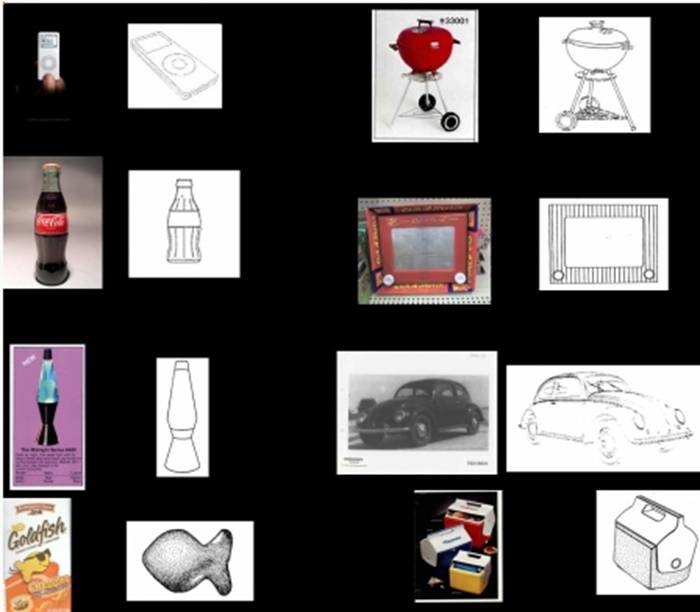
Here are some famous shape trademarks I have come across over the years.

Which one is your favorite? (Mine is the fish-shaped cracker)

Iconic Product Shape Trademarks

Note: The product image is followed by the issued trademark.

Google Obtains Design Patent For Its Website

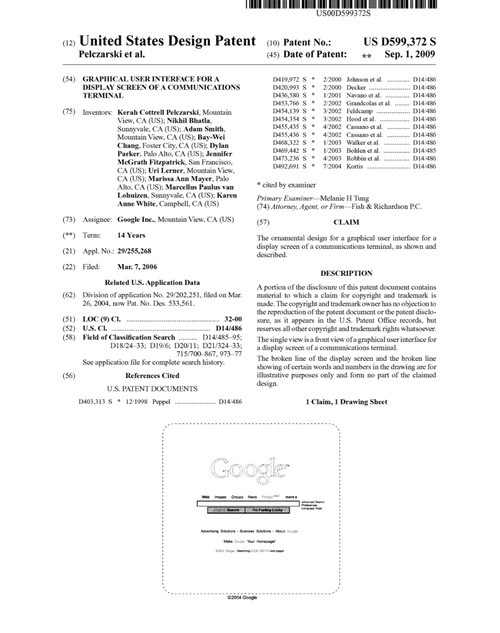
For some time now, I have noticed how Google has obtained several design patents for its website and user interface. See below.

Google Homepage Design Patent

They also recently applied for and obtained a new design patent for the layout of search results. Click here to see it.

A design patent is not your typical patent, and it only secures the aesthetic ornamental aspects of the goods.

Nothing is stopping Google from trademarking its clean, minimalist web interface. In fact, I wrote an article in The Wall Street Journal a while back on how Apple used this very strategy to obtain a shape trademark for its iPod and iPhone.

My most recent search of Google’s nearly 100 live trademarks, however, shows they have yet to learn from Apple’s trademark strategy success.

UPDATE: Please see this newer post to learn about additional ways to secure a website’s design and functionality.

Louis Vuitton Wins a $32 Million Trademark Judgment

That’s a pretty big sum for a trademark infringement case, litigated in a federal court in Northern California. What is interesting is it wasn’t levied against some knock off artists directly. Instead, the charge was contributory infringement (kind of like aiding and abetting) against web site hosts that allowed fake L.V. hand bags to be sold via the Web. This ruling will potentially have a big impact in the world of online retail. The case bears some similarity to Napster, which dealt with copyrights and online music exchanges.  In the L.V. case, however, it will be much harder in the future for fake goods sellers and their web hosts to escape unnoticed. This is, in sum, a big victory for trademark owners.

The full business wire story is here.

To the Folks at Twitter: Use Trademarks to Monetize Your Traffic

I just read an article on a packaging blog that mentions how companies are adding their Twitter ID on product packaging. I agree with the article’s conclusion that it’s a smart marketing move that allows a company using this strategy to stay in touch with customers. Pepsi, for example, added “twitter.com/pepsiraw” to its Pepsi Raw beverage packaging.

Here’s an idea for the folks at Twitter, who have been criticized for not monetizing their customer base. Try licensing your trademarks to companies who want to add the Twitter ID to their product packaging. After all, you own the Twitter trademarks! You can license the brand name and logo for premium royalties, in my opinion.

I ran a quick search and found six live trademarks federally registered to Twitter.

Blogger Sues Goldman Sachs For Domain Rights

It would be an understatement to say that Michael Morgan dislikes Goldman Sachs. Mr. Morgan expresses his vitriol against the large investment bank in not-so-subtle terms. Mr. Morgan writes on his blog: “Yes, I am short Goldman Sachs stock. I believe this company is evil and should not exist. We need to begin to break up companies that have as much control over world finances as Goldman Sachs.”

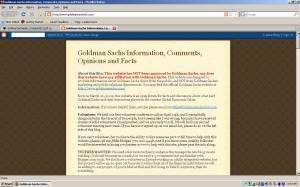
His explicit contempt, however, is not what drew the ire of Goldman Sachs and its attorneys. Instead, it’s the domain name that Mr. Morgan reserved to express his views. The domain name for Mr. Morgan’s blog is goldmansachs666.com. As Mr. Morgan writes, his blog’s purpose is to serve as “an open forum for facts and discussion about what part Goldman Sachs and their executives played in the current Global Economic Crisis.


goldman

On April 8, 2009 Goldman Sachs’ attorneys fired-off a cease and desist letter to Mr. Morgan. The letter states “your use of the mark Goldman Sachs violates several of Goldman Sachs’ intellectual property rights, constitutes an act of trademark infringement, unfair competition and implies a relationship and misrepresents commercial activity and/or an affiliation between you and Goldman Sachs which does not exist and additionally creates confusion in the marketplace.”
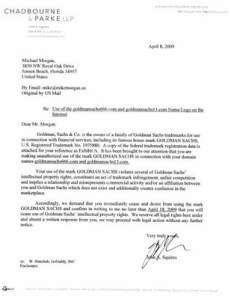
gs_letterimage

Mr. Morgan had several options at that point. He could have ceased using the domain name as requested by the letter. He could have ignored it and risked further legal actions. Or, sue Goldman Sachs and petition a court to uphold his use of the domain name as a legal use, and not a trademark infringement as claimed by Goldman Sachs. Mr. Morgan chose this last option, and has filed a complaint in the United States District Court – South Florida. Click here to read the complaint.
Liquidators Buy Bankrupt Brands For $175 Million

The New York Times has a great story on entrepreneurial companies that have purchased bankrupt company brands. Among them: Sharper Image, Linens ’n Things and Bombay.The price for these three trademark rights is estimated at $175 million.

Borrowing Blue

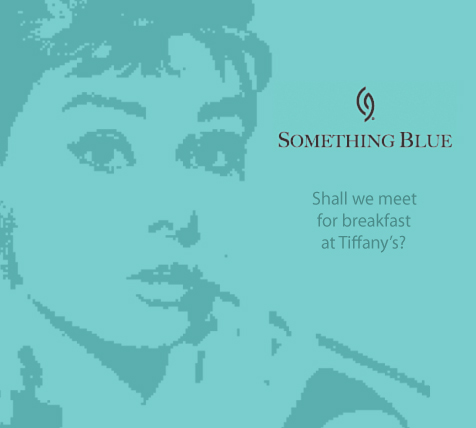
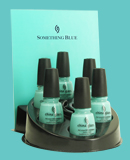
Smart marketing. That is what comes to mind when I think about what China Glaze has done with the branding behind its For Audrey nail polish. Take a look at the product.

For Audrey Nail Lacquer Ad
Something Blue Counter Display

Did you notice the clever associations the nail polish company created by relating the product to the blue color associated with an iconic jewelry store? Or the movie with that store’s name?

On its Web site, China Glaze calls this product a “Tiffany inspired turquoise creme nail lacquer”. But the word “Tiffany” does not appear anywhere on the nail polish bottles or the store displays.

Why is this all so clever? Because the color conjures up images of exclusivity, allure, romance and also a bit of decadence. How did this come about? There is actually a trademark tale behind it all. Tiffany & Co. owns the trademark exclusive rights to use the color robin’s egg blue for boxes, shopping bags, packaging and catalogs in various markets, including fragrances, tableware and crystal. The famous luxury retailer has done a magnificent job of managing this exclusive trademark color in the market for high-end luxury items.

Has China Glaze infringed the color trademark owned by Tiffany & Co.? Not likely since their nail lacquer is not included in the above categories.

Will Google Shut Down Copycat Site?

A student in my Entrepreneurship class recently made me aware of the site: “Let me Google that for you” .com (LMGTFY).

As the name of LMGTFY implies, the site shows you how to search Google if you follow the simple steps listed on the site. I showed the website in class, and one student immediately thought it was a joke. “That’s not so unique” was one comment. “Why not get rid of the middleman and go straight to Google?” another student asked.

As it turns out, the website is dedicated “to all those people that find it more convenient to bother you with their question rather than google it for themselves.” So, if you receive an annoying question, rather than ignore the person or say something nasty, you can send them to LMGTFY and hope they get the message not to bother you again.

The website raises some intellectual property issues, however. I asked the class if they would be willing to invest in this company. The site apparently is trying to raise advertising revenues and claims to have a “steady stream of traffic made up primarily of affluent 30-somethings.” They also claim to have received 1.25 million visitors in February. One student said he would not invest because Google would be able to “shut them down fairly quickly”.

Under what grounds? First, there is the possible trademark issue since the Google trademark and logo are used on the site. Also, the Google website is secured under copyright.

News Brief: Lingerie Entrepreneur gets to Bottom of I.P. Controversy

Pop culture critic and journalist C.E. Hanifin recently pointed out a fascinating intellectual property controversy at Target Addict. That blog comments on a news story run by The Virginian-Pilot, involving I.P. and lingerie.

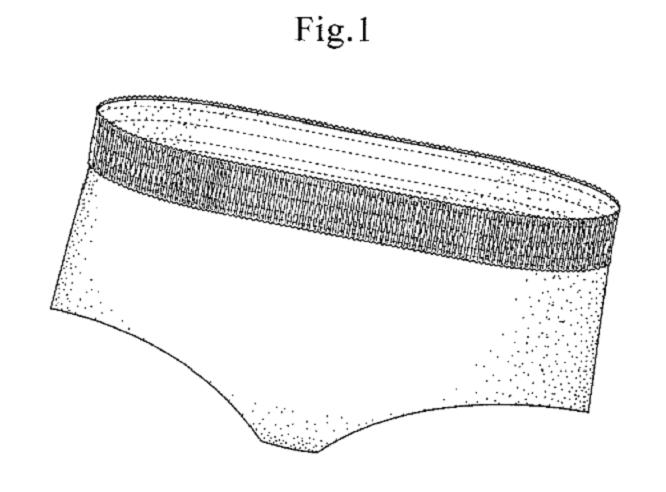
April Spring, of Norfolk Virginia,  obtained a design patent in December, 2008 for a design of women’s briefs marketed under her Foxers brand. This is the image of the design patent, as it was issued by the U.S Patent Office.

Design Patent D581,628 for Women's Briefs

Spring’s design attaches an elastic waist band to the briefs, much like those seen on men’s boxer shorts.

Spring filed a lawsuit against Target, Corp. alleging the retailer knocked-off her design. The Foxers briefs are normally priced at between $20 to $26 a pair. The Target briefs that allegedly rip-off her design are priced at around $5 a pair.

Note: design patents are a special type of patent and differ from utility patents, which cover working inventions. Design patents cover only the ornamental look of a product, as opposed to how the product works.

Matsuflex

“I have the name Matsuflex. If I can harness that Matsuflex energy, it’s gonna help change America in a positive way!”

Matsuflex
Matsuflex

These are the words of Ryan Matsunaga, a.k.a. Matsuflex, one of the participant’s on VH1’s reality t.v. show The Tool Academy. Matsuflex, is one of the program’s finalists and has made a point of advertising his name as often as possible. During a recent show, one of the show’s attendee’s asked “What’s Matsuflex? It sounds like an energy drink.” Here’s another suggestion, a Matsuflex sounds like a pull-up machine hawked on late night t.v. The point is, the name Matsuflex may have real commercial value.

If that is the case, Matsuflex would do well to trademark the name as soon as possible. I ran a quick search at the United States Patent and Trademark Office (USPTO) database and was unable to find a trademark registered as Matsuflex, which means it is still open for someone to claim, so long as they can prove they will offer something for sale called Matsuflex in a particular class of goods or services.

Matsuflex should think about running to the USPTO to claim the name, if he hasn’t done so already. Otherwise, an unscrupulous entrepreneur might take it over, and misappropriate all that positive Matsuflex energy.